Free chartGnostic Cosmology
Gnostic Cosmology Chart
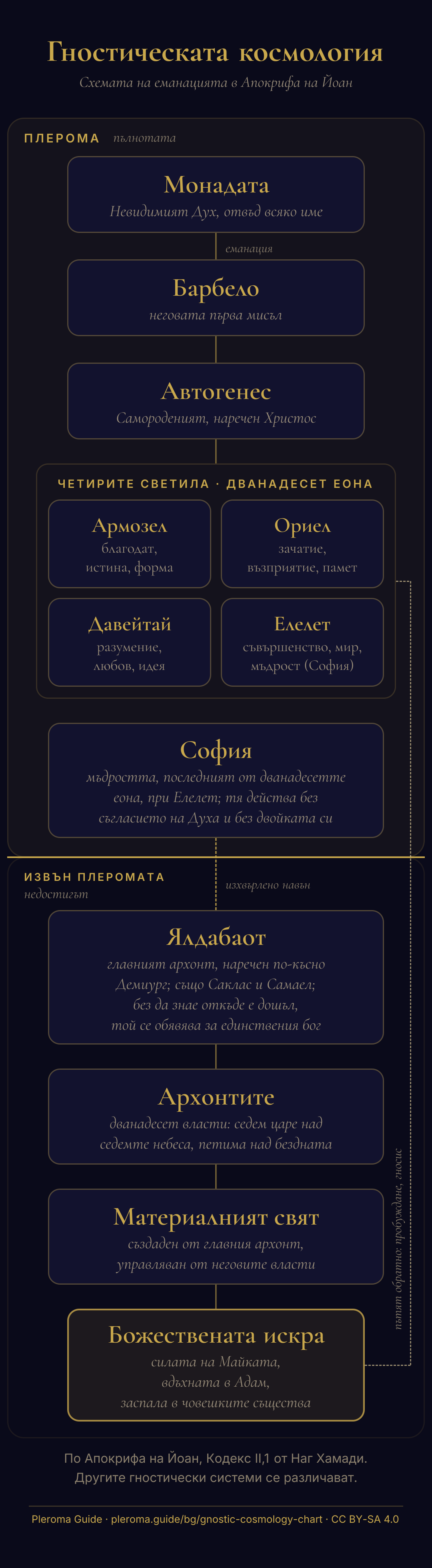
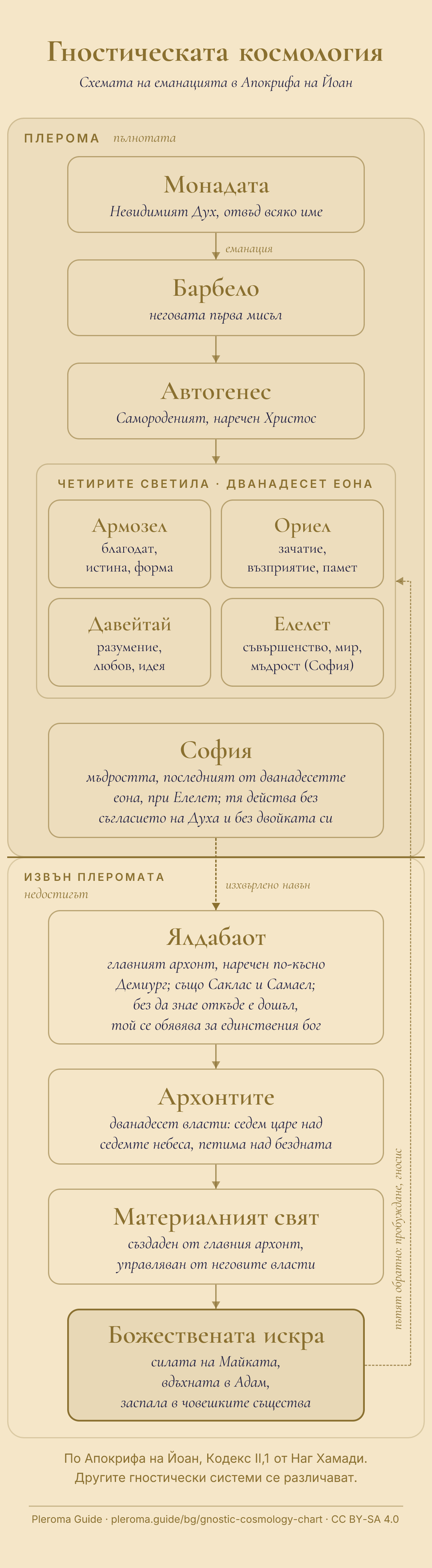
This Gnostic cosmology chart draws the Sethian scheme of the Apocryphon of John on one page: the Monad, Barbelo and the Autogenes, and the four lights with their twelve aeons, the last of them Sophia, inside the Pleroma; outside it, Yaldabaoth, his archons and the material world, where the power of the Mother, the divine spark, sleeps in human beings. It is free to download as SVG or PNG, in English and Bulgarian, under CC BY-SA 4.0.
The chart
After the Apocryphon of John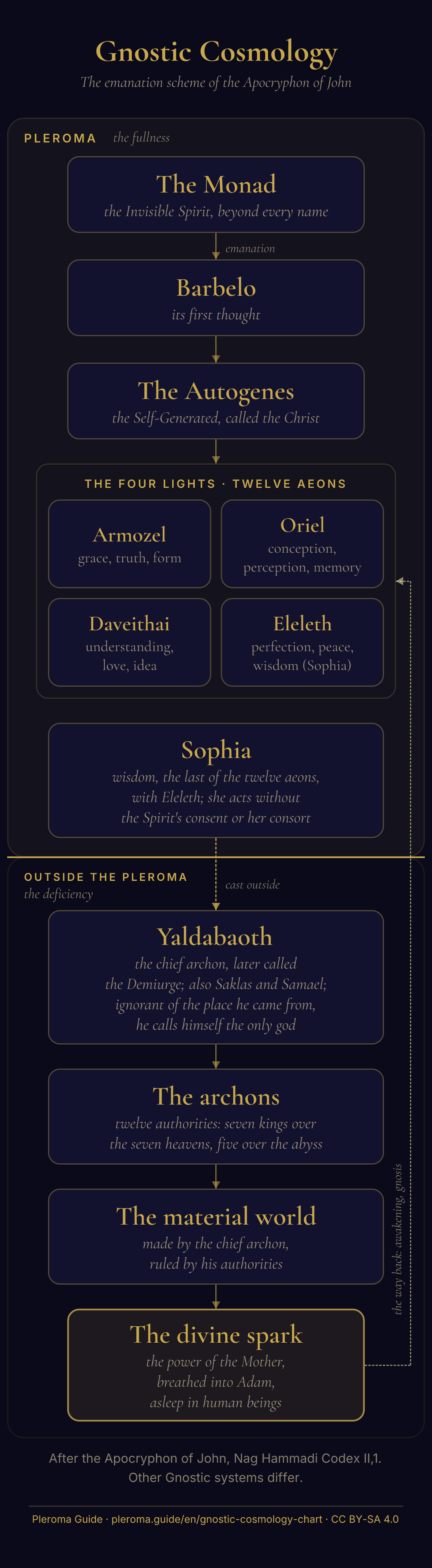
Reading key
- Emanation: each figure comes forth from the one above it.
- The gold line marks where the Pleroma ends. The text names no boundary; it says only that Sophia's offspring was cast outside.
- What Sophia brings forth alone, cast outside the Pleroma.
- The way back: woken from sleep, the soul returns to the aeons of the four lights.
Reading
How to read it
Read the chart from the top down. The upper field is the Pleroma, the fullness; everything below the gold line lies outside it, in the deficiency. The line is only a drawing device: the Apocryphon of John names no boundary and says only that Sophia's offspring was cast outside. The solid lines are emanation: each figure comes forth from the one above it, asked for and granted, and nothing in that sequence is a fall.
At the top stands the Monad, the Invisible Spirit, beyond every name. Its first thought is Barbelo. When the Spirit looks at Barbelo in the pure light, the Autogenes comes forth, the Self-Generated, whom the Apocryphon of John calls the Christ. Four lights attend the Autogenes, each with three aeons beside it, twelve in all.
The last of the twelve aeons, the third with the fourth light Eleleth, is wisdom, Sophia in Greek. The Sophia box below the four lights is that same aeon drawn again, because the story turns on her; she is not a thirteenth figure. She acts without the Spirit's consent and without her consort, and what she brings forth is cast outside the Pleroma, which is where the dashed line crosses the gold one. That offspring is Yaldabaoth, whom the text calls the chief archon and who also bears the names Saklas and Samael; ignorant of the place he came from, he calls himself the only god.
Yaldabaoth brings forth twelve authorities, then sets seven kings over the seven heavens and five over the depth of the abyss, and he makes the material world they rule. Without knowing it, he breathes the power of the Mother into Adam, and that power sleeps on in human beings; the divine spark is the later, common name for it. The chief archon brings forgetfulness over them, so that they do not know where they came from. The thin line on the right is the way back: woken by the call of Pronoia, the soul returns to the aeons of the four lights. Other Gnostic texts describe that return as an ascent through the spheres of the archons.
The text also says who lives in each light:
- Armozel, the first light: grace, truth and form. The perfect Man, Pigera-Adamas, is set over the first aeon.
- Oriel, the second: conception, perception and memory. Seth is set over the second aeon.
- Daveithai, the third: understanding, love and idea. The seed of Seth goes there, with the souls of the saints.
- Eleleth, the fourth: perfection, peace and wisdom, the aeon the story calls Sophia. It receives the souls of those who did not know the fullness and repented only after a while.
This chart follows the Apocryphon of John. The Valentinian system known from Irenaeus counts thirty aeons in pairs, makes Sophia the youngest of them and tells her fall differently; Kenoma, the emptiness outside the fullness, and Horos, the boundary, are Valentinian terms that this text does not use. The Nag Hammadi texts do not agree on every name or number either. The spelling Armozel is the one in Wisse's translation; Harmozel is just as common. Wisse prints Yaltabaoth; the chart uses the common form, Yaldabaoth.
Use this chart
Licence
Free to copy, print, adapt and share, also commercially, under CC BY-SA 4.0: credit Pleroma Guide with a link to this page, and share adaptations under the same licence.
Cite this page
Copy-ready references for this page. The accessed date is today's.
Stefan's Alkimia. (2026, November 15). Gnostic Cosmology Chart. Pleroma Guide. https://pleroma.guide/en/gnostic-cosmology-chart
Stefan's Alkimia. “Gnostic Cosmology Chart.” Pleroma Guide, 15 Nov. 2026, pleroma.guide/en/gnostic-cosmology-chart.
Stefan's Alkimia. “Gnostic Cosmology Chart.” Pleroma Guide. November 15, 2026. https://pleroma.guide/en/gnostic-cosmology-chart.
@online{alkimia2026gnosticcosmologychart,
  author = {{Stefan's Alkimia}},
  title = {{Gnostic Cosmology Chart}},
  organization = {{Pleroma Guide}},
  date = {2026-11-15},
  year = {2026},
  url = {https://pleroma.guide/en/gnostic-cosmology-chart},
  langid = {english}
}
Attribution line
Gnostic Cosmology Chart by Pleroma Guide, https://pleroma.guide/en/gnostic-cosmology-chart, CC BY-SA 4.0
Embed on your site (HTML)
<a href="https://pleroma.guide/en/gnostic-cosmology-chart"><img src="https://pleroma.guide/charts/gnostic-cosmology-chart-en.png" alt="Gnostic cosmology chart of the Apocryphon of John, from Pleroma Guide" width="1080" height="3918" loading="lazy"></a>
One click selects a whole box; then copy it.
Questions
Questions about the chart
What does the Gnostic cosmology chart show?
The emanation scheme of the Apocryphon of John, from the Monad at the top to the material world at the bottom: Barbelo, the Autogenes, the four lights with their twelve aeons and Sophia inside the Pleroma; outside it, Yaldabaoth, whom Sophia cast out, his archons and the material world; and the divine spark, the power of the Mother asleep in human beings, with its way back to the aeons of the four lights.
Can I use the chart on my site, in a class or in a book?
Yes. The chart is published under CC BY-SA 4.0: you may copy, print, adapt and share it, also commercially, as long as you credit Pleroma Guide with a link to this page and share any adaptation under the same licence. A ready attribution line and an embed snippet are in the panel above.
Why does the chart follow the Apocryphon of John?
It is the fullest Sethian account of the whole sequence, and it survives in four Coptic manuscripts: three from Nag Hammadi, Codices II, III and IV, copied in the fourth century, and the Berlin Codex, BG 8502, from the fifth. The Nag Hammadi find alone holds three copies. Other systems differ. The Valentinian one that Irenaeus reports counts thirty aeons in pairs and names a boundary around the Pleroma, Horos, where the Apocryphon of John names none.
Is the Demiurge the same as Yaldabaoth?
They are the same figure, but the Apocryphon of John itself never uses the word Demiurge: it calls him the chief archon and gives him three names, Yaldabaoth, Saklas and Samael. Demiurge is the name other Gnostic systems and modern scholars use for this figure. The word is Greek for craftsman; Plato used it neutrally in the Timaeus, and the Gnostic texts made it the name of a lesser power who mistakes himself for the highest.
How many archons are there?
The Apocryphon of John names twelve authorities first, then sets seven kings over the seven heavens and five over the depth of the abyss. Seven is the number most people know; other Gnostic texts match the seven to the planetary spheres.
Read on