Free chartConsciousness Frequencies
Hawkins Scale of Consciousness Chart
This chart lays out the seventeen levels of the Hawkins scale of consciousness as David R. Hawkins set them out in Power vs. Force (1995), from Shame at 20 to Enlightenment at 700 to 1,000, with Courage at 200 as the line he drew between Force and Power. Select a level to see Hawkins's number for it and a one-line gloss. The numbers are Hawkins's calibrations, made by muscle testing, a method blinded tests have not supported: read them as his ordering of inner states, not as measurements.
The scale
Hawkins's calibrations, not measurementsPower · 200 and above
In short
the sages' range; the ceiling of his scale
In short
stillness; the separate self begins to thin
In short
Love as a baseline; it sits under sorrow
In short
unconditional, needing no object; not romance
In short
rigorous inquiry; often a ceiling taken for the top
In short
responsibility for one's own experience
In short
the genuine yes; turned toward growth
In short
outcomes no longer life-or-death; either way is fine
In short
the first level that can afford honesty
Force · below 200
In short
the top of Force; it needs someone lower
In short
rage and resentment; a way out of victimhood
In short
craving; pursuit with no point of rest
In short
anxiety and constant scanning for threat
In short
loss, regret, sadness; painful, but moving
In short
hopelessness and helplessness
In short
identified with wrongdoing; a self-judge appears
In short
the lowest level: the self-image is the wound
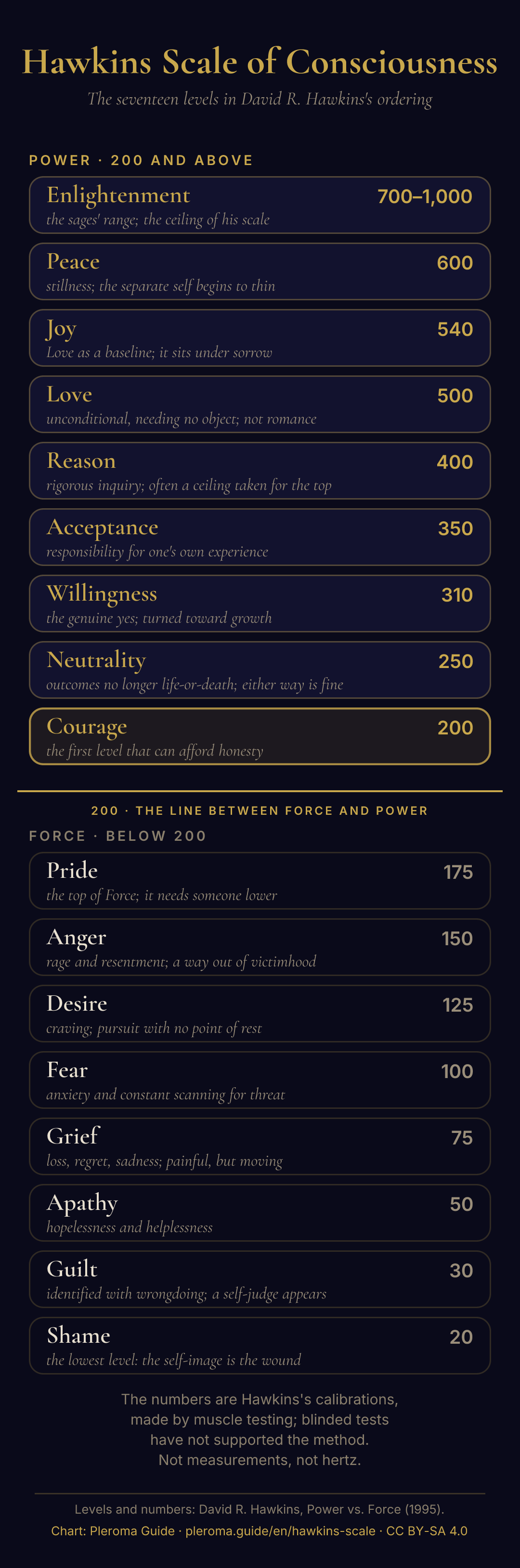
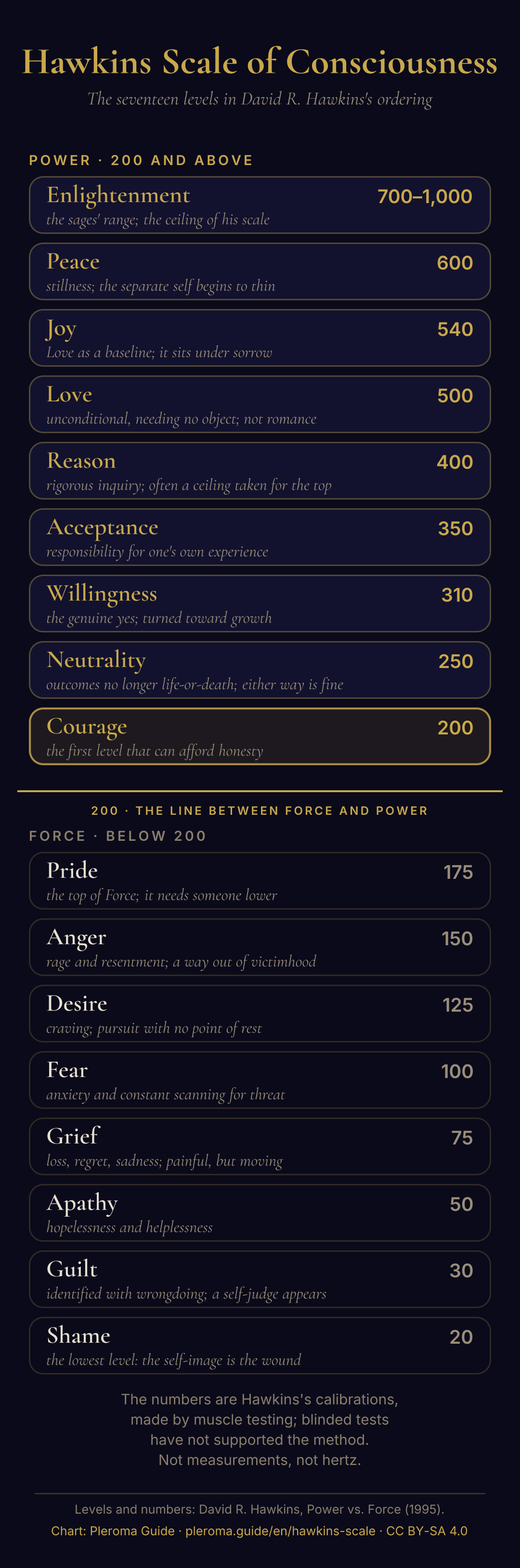
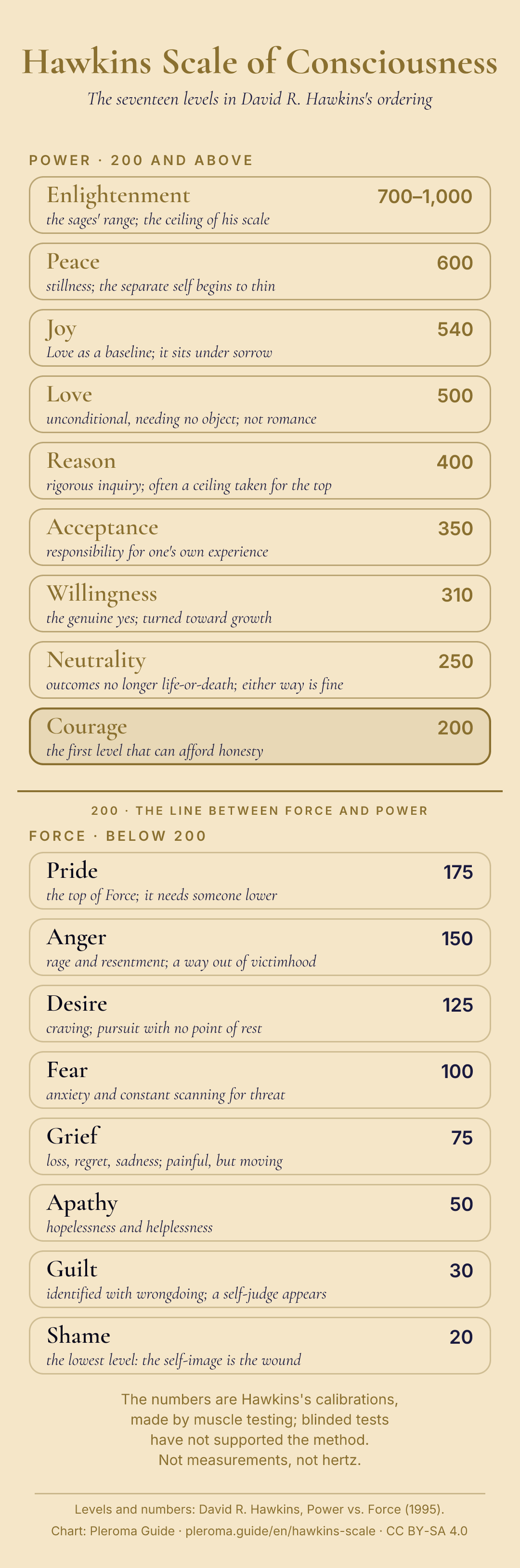
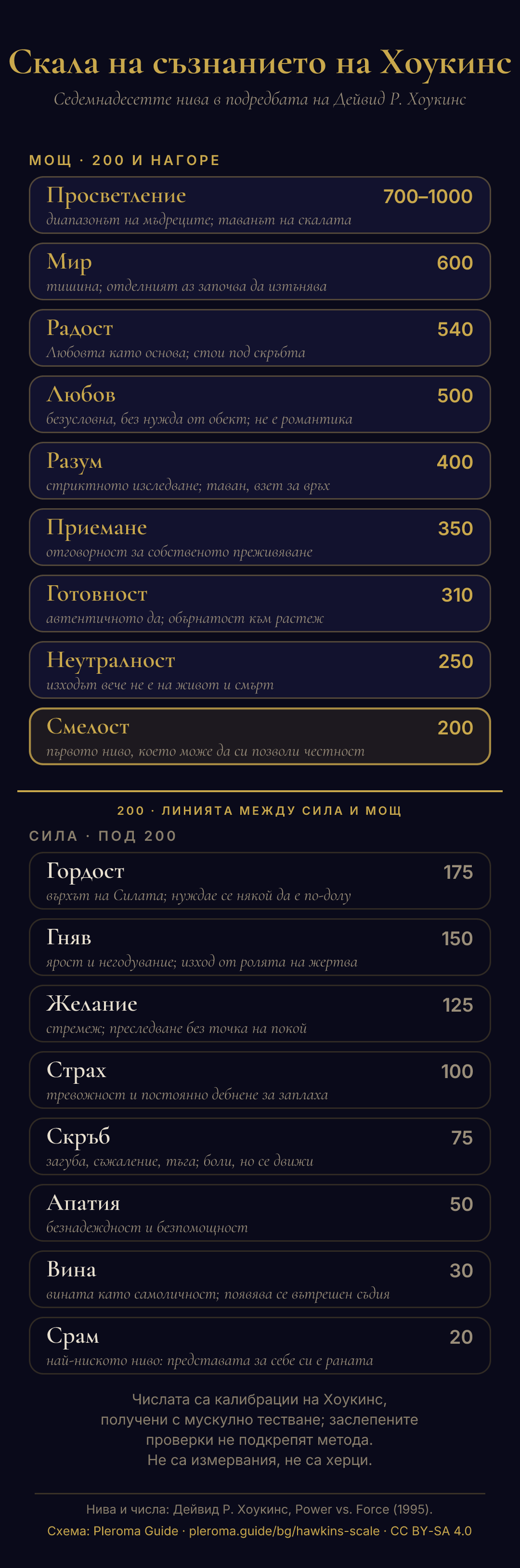
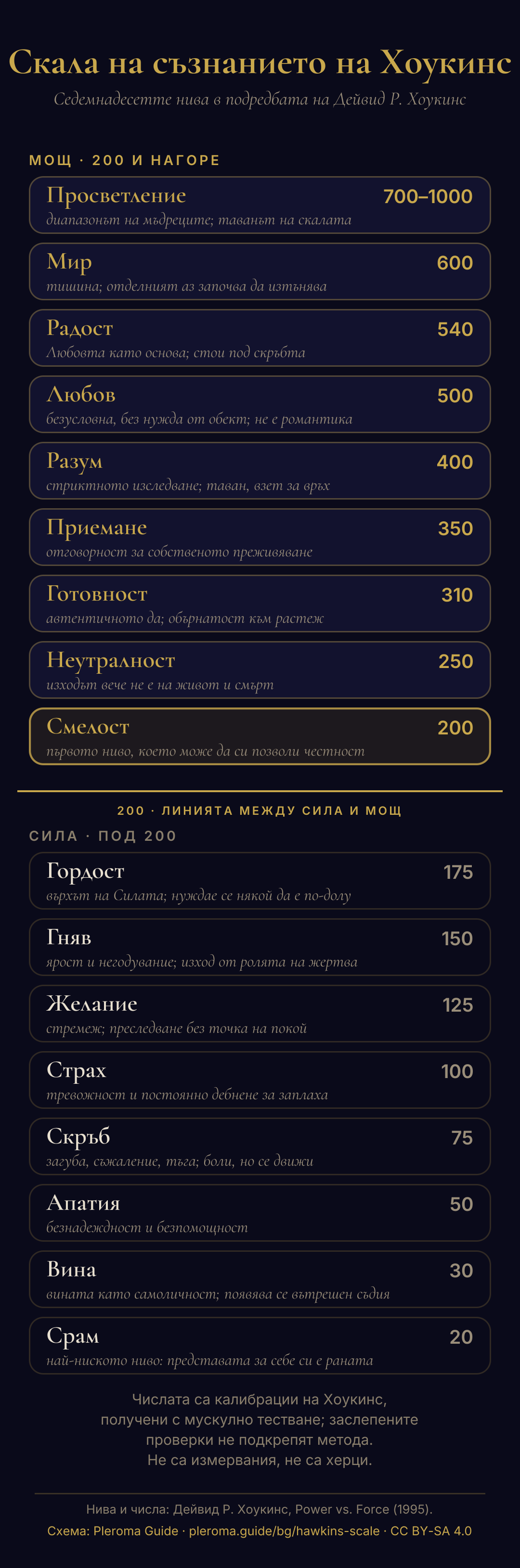
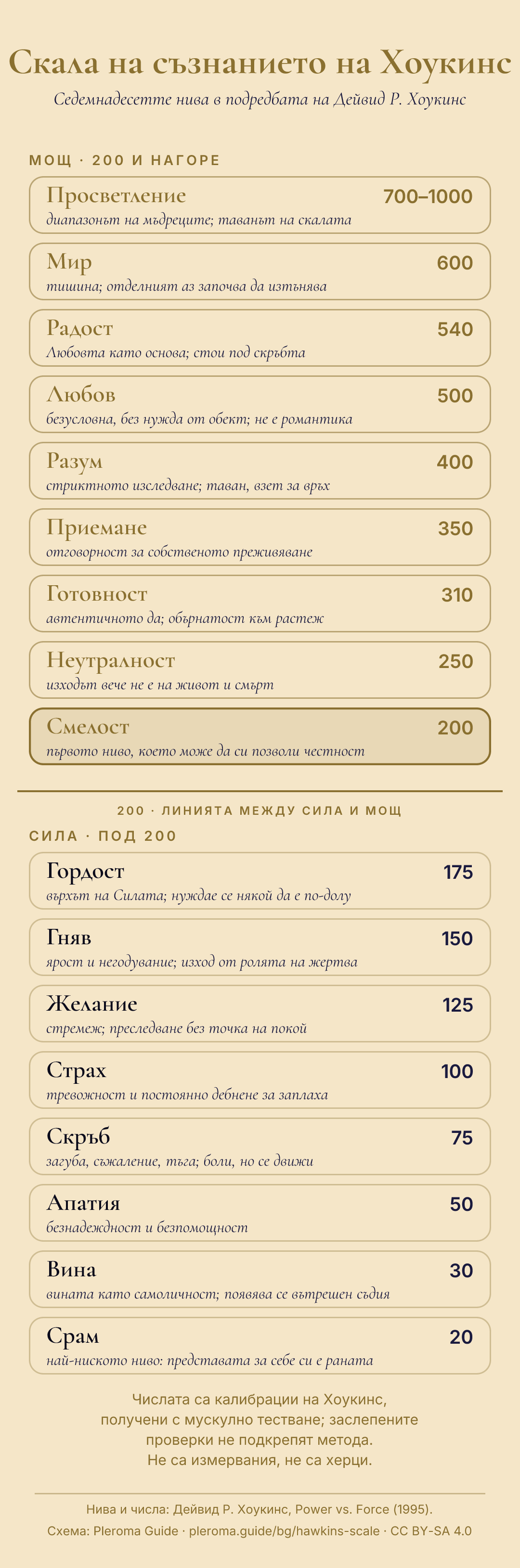
Every number here is Hawkins's own, produced by muscle testing. Blinded tests have not supported that method, so read the numbers as his ordering, not as a measurement and not as hertz.
Where the numbers come fromReading
How to read it
Read the scale from the bottom up. Hawkins arranged the levels from the most contracted state, Shame, to the most open, Enlightenment, and gave each a number between 1 and 1,000 on what he called a logarithmic scale. On his account the steps are not even: each stands for a vast multiplication rather than an increment, which is why the numbers bunch below 200 and spread out above it.
The gold line is Courage, at 200. Hawkins called the levels below it Force, states that depend on opposition and consume more than they give, and the levels above it Power, states that work by alignment. He treated two crossings as the hardest on the map: the one at 200, and the move from Reason at 400 to Love at 500.
Use it as a vocabulary. Many readers recognise their own states on it, and the ordering is the useful part. It is not a test and it places no one at a number: a person moves across a wide range in a year, a week, sometimes an hour.
Seventeen
The seventeen levels
The whole scale in one table, top to bottom, with Hawkins's number for each level and a one-line summary. The summaries are this site's, not quotations from Hawkins.
| Level | Hawkins's number | |
|---|---|---|
| Enlightenmentthe sages' range; the ceiling of his scale | 700–1,000 | the sages' range; the ceiling of his scale |
| Peacestillness; the separate self begins to thin | 600 | stillness; the separate self begins to thin |
| JoyLove as a baseline; it sits under sorrow | 540 | Love as a baseline; it sits under sorrow |
| Loveunconditional, needing no object; not romance | 500 | unconditional, needing no object; not romance |
| Reasonrigorous inquiry; often a ceiling taken for the top | 400 | rigorous inquiry; often a ceiling taken for the top |
| Acceptanceresponsibility for one's own experience | 350 | responsibility for one's own experience |
| Willingnessthe genuine yes; turned toward growth | 310 | the genuine yes; turned toward growth |
| Neutralityoutcomes no longer life-or-death; either way is fine | 250 | outcomes no longer life-or-death; either way is fine |
| Couragethe first level that can afford honesty | 200 | the first level that can afford honesty |
| Pridethe top of Force; it needs someone lower | 175 | the top of Force; it needs someone lower |
| Angerrage and resentment; a way out of victimhood | 150 | rage and resentment; a way out of victimhood |
| Desirecraving; pursuit with no point of rest | 125 | craving; pursuit with no point of rest |
| Fearanxiety and constant scanning for threat | 100 | anxiety and constant scanning for threat |
| Griefloss, regret, sadness; painful, but moving | 75 | loss, regret, sadness; painful, but moving |
| Apathyhopelessness and helplessness | 50 | hopelessness and helplessness |
| Guiltidentified with wrongdoing; a self-judge appears | 30 | identified with wrongdoing; a self-judge appears |
| Shamethe lowest level: the self-image is the wound | 20 | the lowest level: the self-image is the wound |
Sources
Where the numbers come from
David R. Hawkins (1927–2012) was a psychiatrist by training. He set out the scale and its method in Power vs. Force, published by Veritas in 1995 and reissued by Hay House in 2002, and expanded it in later books, Transcending the Levels of Consciousness (2006) among them.
Every number on the scale came from applied kinesiology, that is, muscle testing: a subject holds out an arm, a question is put, and the tester presses down and judges whether the arm holds or gives. Hawkins called the results calibrations. Tested blind, the method has not performed better than chance. In a 1988 trial, kinesiologists assessing nutrient status agreed neither with each other nor with laboratory tests; in a 2001 trial with allergy patients, agreement came out indistinguishable from none. The numbers are therefore not measurements of anything outside the person doing the testing, and they are not hertz.
The territory is older than the numbers. Contemplative traditions mapped the same ascent in their own words: the Eastern Orthodox vocabulary of watchfulness, stillness and contemplation, Evagrius's list of the thoughts that come at a monk sitting still, the stages of the bodhisattva path, the stations of the Sufis. Hawkins's map also invites comparison with the stage models of modern developmental psychology, from Piaget, Kohlberg and Maslow. What he added was a numbering. What survives the failed method is the ordering, which a reader can only check against experience.
This site also reads the map beside the Gnostic three natures, hylic, psychic and pneumatic, in the essay linked below. That pairing is the site's reading, not Hawkins's.
Use this chart
Licence
Free to copy, print, adapt and share, also commercially, under CC BY-SA 4.0: credit Pleroma Guide with a link to this page, and share adaptations under the same licence.
Cite this page
Copy-ready references for this page. The accessed date is today's.
Stefan's Alkimia. (2026, November 15). Hawkins Scale of Consciousness Chart. Pleroma Guide. https://pleroma.guide/en/hawkins-scale
Stefan's Alkimia. “Hawkins Scale of Consciousness Chart.” Pleroma Guide, 15 Nov. 2026, pleroma.guide/en/hawkins-scale.
Stefan's Alkimia. “Hawkins Scale of Consciousness Chart.” Pleroma Guide. November 15, 2026. https://pleroma.guide/en/hawkins-scale.
@online{alkimia2026hawkinsscale,
  author = {{Stefan's Alkimia}},
  title = {{Hawkins Scale of Consciousness Chart}},
  organization = {{Pleroma Guide}},
  date = {2026-11-15},
  year = {2026},
  url = {https://pleroma.guide/en/hawkins-scale},
  langid = {english}
}
Attribution line
Hawkins Scale of Consciousness Chart. Levels and numbers: David R. Hawkins, Power vs. Force (1995). Chart: Pleroma Guide, https://pleroma.guide/en/hawkins-scale, CC BY-SA 4.0
Embed on your site (HTML)
<a href="https://pleroma.guide/en/hawkins-scale"><img src="https://pleroma.guide/charts/hawkins-scale-en.png" alt="Hawkins scale of consciousness chart, seventeen levels from Shame to Enlightenment, from Pleroma Guide" width="1080" height="3258" loading="lazy"></a>
One click selects a whole box; then copy it.
Questions
Questions about the scale
What is the Hawkins scale of consciousness?
A map of seventeen human states that David R. Hawkins set out in Power vs. Force (1995), from Shame at 20 to Enlightenment at 700 to 1,000, with Courage at 200 as its hinge. The numbers are his calibrations, made by muscle testing, so read the scale as an ordered description of inner states, not as a measurement.
Are the Hawkins levels frequencies in hertz?
No. Nothing on the scale is measured in hertz, or measured at all. Frequency is borrowed vocabulary for a dominant state; the numbers are Hawkins's notation, produced by muscle testing.
Is the Hawkins scale scientifically valid?
No. Applied kinesiology, the muscle testing behind every number, has not performed better than chance once the tester is blinded to what is being tested. What remains is a descriptive map, which many readers find recognisable.
What does 200 mean on the Hawkins scale?
200 is Courage, the line Hawkins drew between Force and Power: below it, states he said consume energy, such as shame, fear and pride; above it, states he said generate it, such as neutrality, reason and love.
Can this chart tell me my level?
No, and it does not try. Hawkins's method cannot place anyone, and a person moves across many levels in a single week. The chart is a vocabulary for noticing states, not a test.
Can I use the chart?
Yes. The chart, its drawing and its glosses are published under CC BY-SA 4.0: copy, print and adapt it, also commercially, with credit to Pleroma Guide and a link to this page, and keep the credit to Hawkins and Power vs. Force (1995) for the levels and numbers.
Read on